 English
Every grower eventually asks the same question: did the plant underperform because of the seed, or because of the room? Genetics and environment both write part of the answer. The line sets the range a plant can reach. The room decides where inside that range it actually lands. Once you see it that way, most yield arguments get a lot simpler.
What genetics actually locks in
Genetics fixes the ceiling. It decides the shape of the plant, the stretch after the flip, the internode spacing, the flowering time and how densely the buds pack. Those traits sit in the seed before you ever plant it. You can nudge them, but you cannot rewrite them.
That is why two growers with the same tent and the same feed end up with very different numbers. One started from a compact, heavy-flowering line such as Gelato 41 feminized. The other started from a stretchy, airy one. In addition, genetics decides how forgiving a plant is. Some lines shrug off a hot week. Others sulk for a fortnight.
What the environment decides
The environment decides how much of that ceiling you actually collect. Light is the first lever, because photosynthesis keeps scaling with usable light until the plant runs short of CO2 or water. After that come temperature, humidity, airflow and root health. Each one can quietly cap the result.
In practice, most disappointing harvests come from a room that looked fine on average but went wrong at the worst moment. A single week at 32 °C during peak flower costs more than a whole month of slightly low light. For example, late heat thins the buds and drives off terpenes, and no line is immune to that.
Stress and timing: the third player
Stress is where the two meet. The same heat spike does different damage depending on when it lands. Early in veg, the plant usually shrugs it off. During week six of flower, it does not.
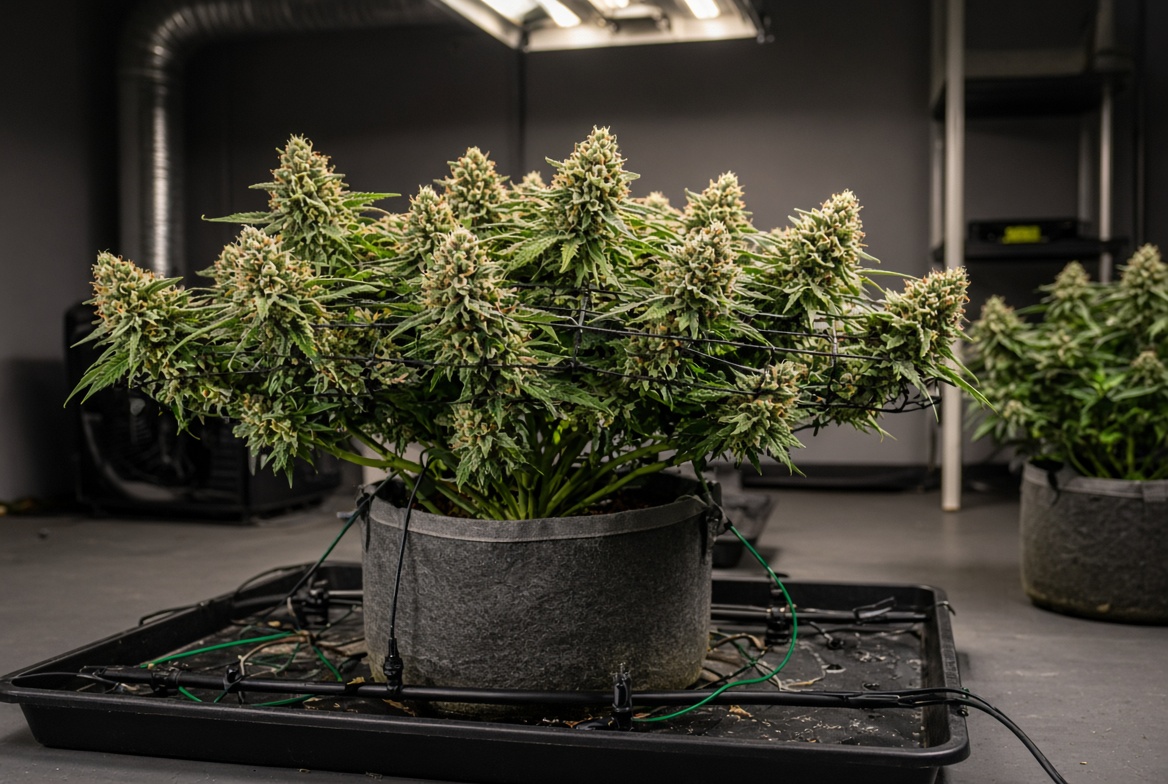
Timing matters for feeding too. Nitrogen that arrives late keeps the plant green when it should be ripening. As a result, the harvest window slides and quality drops. The line did not fail. The calendar did.
Why the two are so hard to separate
Growers rarely change one thing at a time. A new pack of seeds usually arrives alongside a new light, a new medium or a new feed schedule. Therefore, when the result improves, nobody can say what deserves the credit.
Breeders solve this with controls: one room, one cycle, several lines side by side. You can borrow the method on a small scale. Keep one known line in every run as a reference — a stable classic like Blueberry feminized works well. If your reference drops, the room changed. If only the new line drops, the line is the difference.
The rule of thumb that works in practice
A simple split helps: genetics sets the range, the environment picks the point inside it. A strong line in a mediocre room usually beats a mediocre line in a perfect room. Still, neither pairing reaches what the two could do together.
So the order of work is clear. First fix the obvious environmental limits — light, heat, airflow, drainage. Then, once the room holds steady, swapping the line finally tells you something real.
Genetics and environment in the harvest: what each one adds
Both contribute to weight, though they do it differently. Genetics decides bud structure, the calyx-to-leaf ratio and how tightly the flower packs. The environment decides how many of those sites actually fill out.
Quality follows the same split. The terpene profile is written into the line, and a pungent classic like Cheese feminized carries it in the seed. How much of it survives depends on temperature, on the last fortnight of the cycle and on the dry. A hot, fast dry strips a great profile. Meanwhile, a careful dry cannot invent one that was never there.

When the line really is the problem
Sometimes it truly is the seed. The signs are fairly clear: the plants grow evenly and look healthy, the room measures fine, and the result is still thin. Another sign is a pack that throws wildly different plants from the same batch.
Unstable stock shows up as scattered flowering times, very different heights and inconsistent smell. However, before you blame the breeder, check that every plant got the same light and the same water. Edge plants in a tent often tell a different story than the ones sitting under the centre of the lamp.
What to track so you can see the difference
You do not need a lab. Four numbers per cycle are enough:
- Average canopy temperature, plus the highest spike and the date it happened.
- Days from flip to harvest, per plant.
- Dry weight per plant and per square metre.
- One line of notes on smell and bud structure at harvest.
After three cycles the pattern appears on its own. Also, photograph the canopy at the flip and again at week four. Pictures catch stretch differences that numbers quietly miss.
What this means when you choose seed
Buy the line for the room you actually have, not the one you wish you had. A short, fast, sturdy line suits a small tent with imperfect climate control. A tall, long-flowering line rewards height, steady temperature and patience.
Besides that, read what a line is known for rather than what it promises. Flowering time, stretch factor and resistance predict your result far better than any headline number.
How to read a disappointing harvest
Start with the plant itself, because it usually records what happened. Thin, airy tops with healthy leaves point at light or heat. Dense tops on a small plant point at a short veg. Meanwhile, uneven ripening across one plant almost always points at airflow or an unbalanced canopy.
Then look at your notes. If the spike in temperature lines up with the week the buds stopped swelling, you already have your answer. If nothing in the log stands out, and the room ran clean from flip to chop, the line deserves a second look.
Finally, resist changing five things at once for the next run. Change the single factor your notes flagged, keep everything else identical, and the next harvest will tell you whether genetics and environment were really the pair you suspected.
Testing one variable at a time
Changing the lamp, the medium and the feed in the same run makes any conclusion impossible. However, that is exactly what most growers do after a disappointing harvest. Therefore change one thing per cycle and keep everything else identical. Consequently, after three runs you know precisely what moves the needle in your own room. In addition, this discipline stops you spending money on products that changed nothing.
Where the environment matters most
Genetics set the ceiling, yet the environment decides how much of that ceiling you reach. Yield is the trait most influenced by outside factors, which is why the same pack performs so differently in two houses. By contrast, flowering time stays far more stable and therefore makes a better yardstick when you judge a line.
Measure before you change anything
Record the minimum and maximum temperature for a full week. Note the volume of water per plant and the gap between waterings. Then look at the numbers rather than at your memory. As a result, decisions stop being guesswork and start being maintenance.
Frequently asked questions
Is genetics or environment more important for yield?
Neither wins outright. Genetics sets the range, while the environment decides where you land inside it. In a room with real problems, fixing the room gives the bigger jump first.
Can a great environment fix weak genetics?
Only up to the ceiling of that line. A perfect room collects everything the plant can give, and nothing beyond it.
Why do two plants from the same pack give different results?
Normal variation between siblings explains most of it, and position in the room explains the rest. Wide differences across many plants point to an unstable line instead.
How many cycles before I can blame the line?
Two, provided you keep one known reference line in each of them. Without a reference, you are only comparing against memory.
