 English
The last decision of a grow is also the most consequential one. When to harvest decides how the flower smells, how much it weighs and how it finally feels. Even so, many growers watch the calendar, while the plant itself speaks far more clearly.
Why the calendar is not enough
Stated flowering times are averages. They assume favourable conditions and a particular phenotype, so in your room the same line may finish a week earlier or later.
Treat the stated duration as a starting point rather than a deadline. From roughly a week before the expected date, check the plants daily.
The strongest signal: the resin glands
The most reliable clue sits in the trichomes, the tiny resin glands on the flower. They start clear, turn milky, and finally take on an amber colour.
Clear means the plant is still working. Milky indicates full maturity. Amber shows that degradation has begun. Most growers cut when the great majority reads milky and a small share has turned amber.
Looking without magnification does not work
The naked eye cannot separate those stages. A cheap jeweller’s loupe or a small USB microscope is enough, as long as you always inspect the same spot.
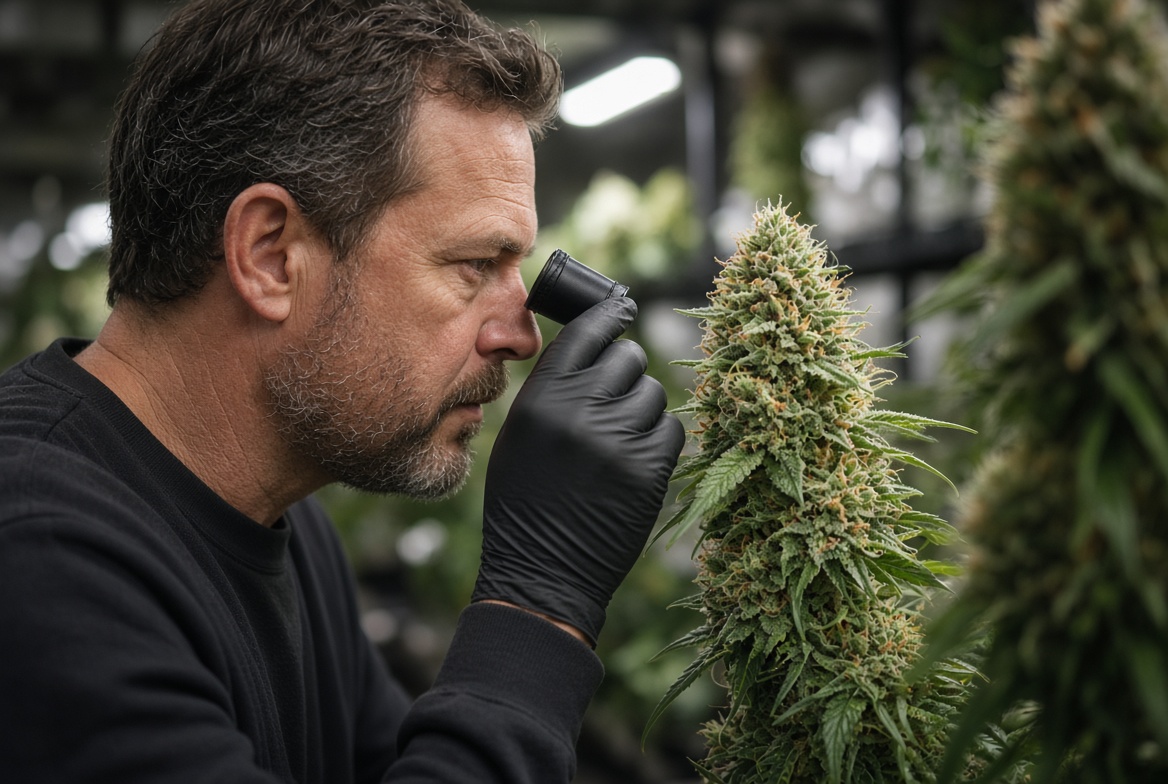
Judge the flower itself rather than the sugar leaves. Leaf material matures faster and therefore signals readiness too early.
Pistils: useful but not decisive
The hairs on the flower, the pistils, shift from white to orange or brown during bloom. That makes a handy check from a distance.
It is not proof, though. Pistils also darken from handling, wind or heat. Use them for a first impression, then confirm with the loupe.
The flower itself: swelling and tightening
During the final fortnight the calyxes visibly swell. The bud grows wider rather than longer, and the structure feels denser to the touch.
Once that swelling stops, the plant is essentially finished. A line such as Critical 2.0 feminized shows this clearly, because the tops tighten noticeably within a few days.
Reading leaf colour without fooling yourself
Yellowing of the lower leaves belongs to the end of flowering. The plant pulls nutrients out of old foliage and moves them into the buds.
Yellowing that begins halfway through bloom means something else entirely. That usually points at a deficiency or root trouble rather than ripeness.
Smell as a supporting clue
As a plant ripens, the aroma shifts from green and sharp towards fuller and sweeter. The change is subtle yet noticeable, especially if you smell daily.
Write that impression down briefly. After two runs you will recognise, on the same line, the exact point where the smell turns.
Early or late: what each one shifts
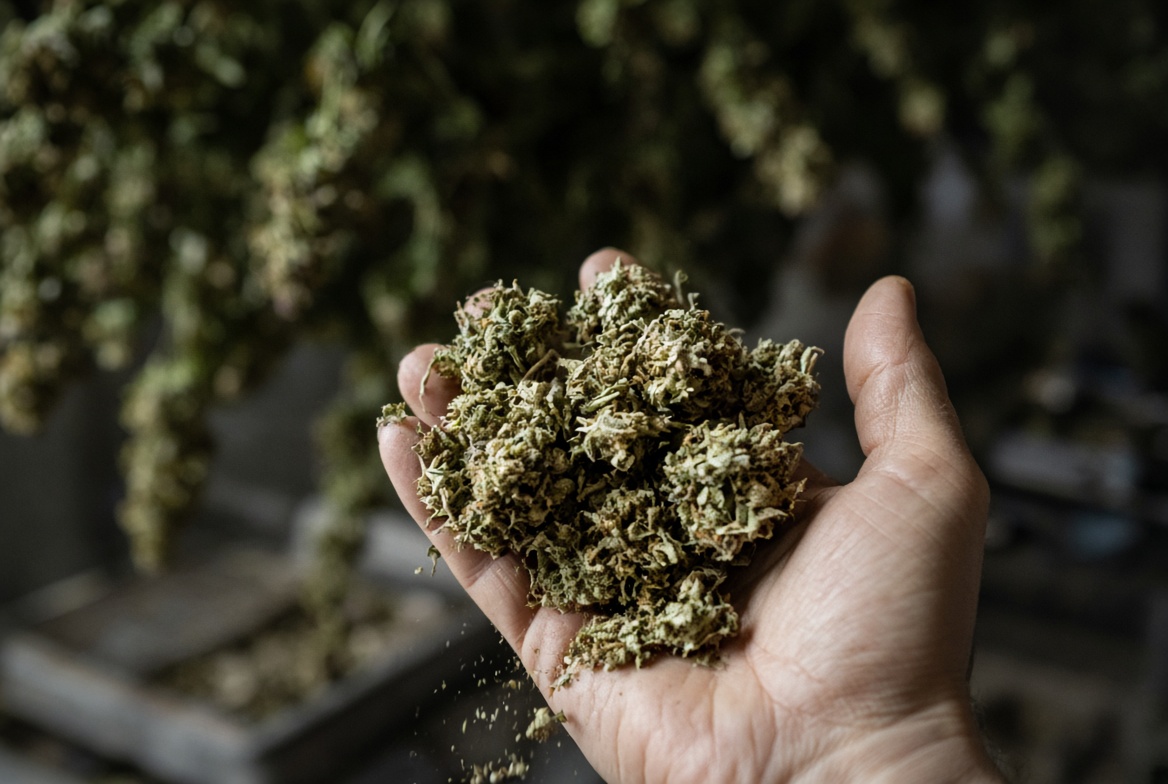
Harvesting earlier usually gives a brighter, sharper flower with lighter notes. Harvesting later gives a heavier, riper impression, while some of the lighter notes disappear.
So no universally correct moment exists. A moment that matches what you want from that line does exist, and comparison is the only way to find it.
Differences between plants in one room
Plants from a single pack rarely ripen together. Edge plants receive less light and consequently lag behind, sometimes by five to seven days.
Harvest per plant, therefore, and not per room. Cutting everything at once nearly always takes part of the crop too early.
Ripening differs within one plant too
Upper tops catch the most light and finish before the lower branches. On tall plants that gap can stretch to a week.
Many growers consequently harvest in two passes. Tops first, the rest a few days later, which gives the lower branches extra light.
The final fortnight: do less
Restraint pays in the closing phase. The plant is no longer building structure, so heavy defoliation only knocks resin glands off.
Keep the room on the cool side and leave the plants alone. A classic like Northern Lights feminized rewards that quiet with a tight, compact finish.
What to record each run
A few notes make the next cycle far easier:
- Days from the flip to harvest, per plant.
- The milky-to-amber ratio at the moment of cutting.
- The highest temperature during the last fortnight.
- A short note on smell and structure after curing.
Two runs are usually enough to learn exactly when to harvest in your particular space.
How to assess a plant systematically
Work the same way every day so your impressions stay comparable. Pick three fixed points on the plant: a main top, a mid-level branch and a lower branch.
Inspect a small area at each point with the loupe, and always judge under white light. Then write one sentence describing what you saw, such as mostly milky with a few amber glands.
Following the same points reveals movement instead of isolated snapshots. That is precisely what choosing the right moment requires.
Autoflowers need a slightly different approach
With autoflowers the clock runs from the seed rather than from a flip. The stated duration therefore tends to be more accurate, although variation between plants remains.
Because the vegetative phase is short, every week carries more weight. Start checking earlier, roughly ten days before the expected date.
What still changes after the cut
Harvest timing does not decide everything. A flower dried too quickly or too warm loses aroma and turns harsh, however well the moment was chosen.
Plan the dry in advance, then. A cool, dark space with gentle air movement protects what the final weeks built.
Common mistakes
The first is cutting early out of impatience. A surprising amount of weight still arrives during the final ten days.
The second is judging under the wrong light. Everything looks amber under a purple lamp, so always assess under white light, outside the grow space.
The third is inspecting one plant and applying the verdict to the rest. A line such as Purple Haze feminized can show clearly different ripening speeds within the same pack.
Trichomes: where to actually look
Many growers check trichomes on the sugar leaves, which ripen earlier than the flower itself. As a result they harvest too soon. Therefore always read the trichomes on the calyx. In addition, use a sixty times loupe, because nobody can separate cloudy from amber with the naked eye.
Pistils mislead more than they help
Pistils darken because of wind, heat or simple contact as well as ripeness. By contrast, trichomes respond mainly to maturation. Therefore treat receding pistils as an early warning and make the final call on trichomes.
Harvesting in two passes
Upper colas ripen before lower branches. Consequently cutting everything on one day mixes ripe material with green material. Therefore take the top third first and leave the rest a few more days. In practice the average quality rises noticeably from this single change.
The gap between the first sign and the cut
Between the first cloudy trichome and the ideal window there are usually seven to ten days. That interval shifts with genetics and room temperature. Therefore start checking daily once you see the first sign, instead of trusting the week count printed on the listing.
Flush timing and ripeness
Many growers stop feeding in the final fortnight. However, that does not speed ripening at all; it only cleans up the flavour. Therefore do not confuse the two decisions. Consequently, keep judging the harvest window by trichomes rather than by your feeding calendar.
Frequently asked questions
Can I rely on the pistils alone?
Better not. Pistils indicate a direction, but they also darken from stress. Resin glands are more reliable.
What if no amber appears at all?
That varies by line. When nearly all glands read milky and the calyxes stop swelling, you can harvest.
Does a dark period before harvest help?
The evidence is thin. A longer dark period does no harm, yet expect no dramatic difference.
Should I flush before harvest?
Opinions differ and solid research is lacking. What matters more is avoiding excess nitrogen during the final weeks.
