 English

Frosted, resinous and sticky appear on more product pages than almost any other descriptors, and all three are pointing at the same underlying trait. Trichome density is one of the most heavily selected characteristics in modern breeding, and it is also one of the least precisely described. It helps to know what the structures actually are before deciding how much weight the claim deserves.
What a trichome is
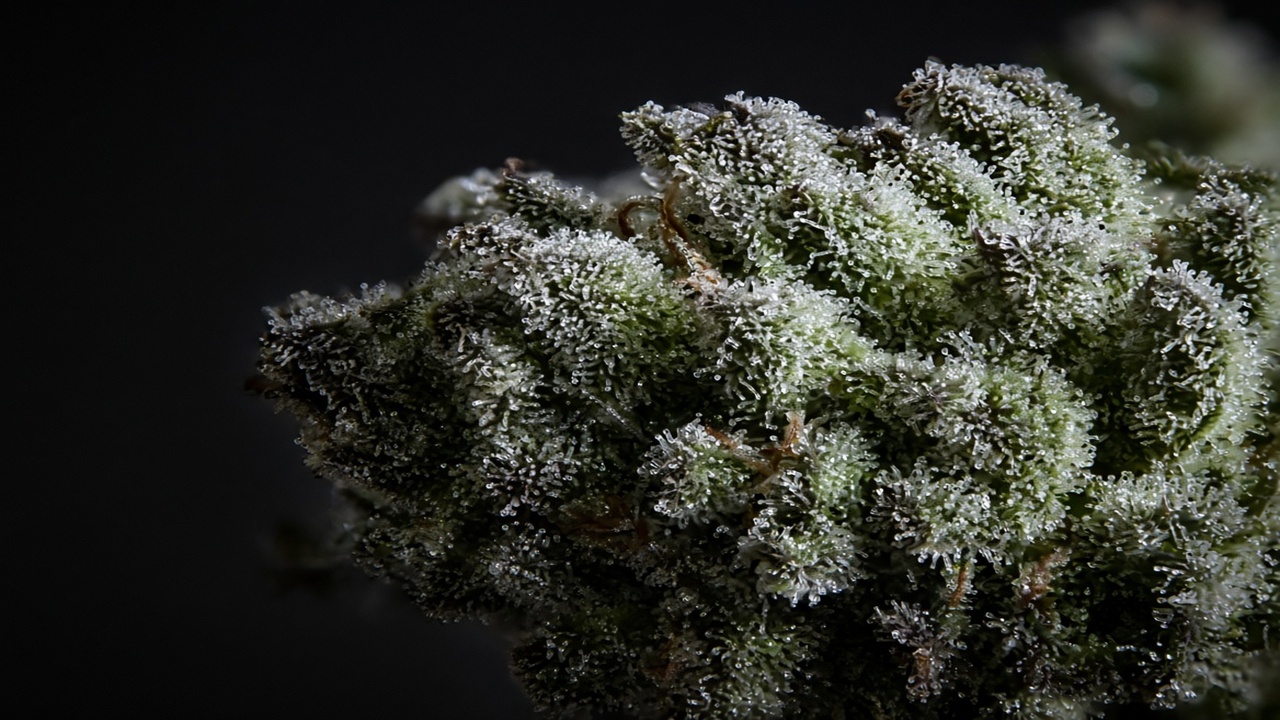
Trichomes are outgrowths of the plant surface, and the word covers a range of structures that look nothing alike under magnification. The ones growers care about are the glandular trichomes: a stalk with a bulbous head, visible to the naked eye as the frosted texture on a mature flower.
Those heads are where the plant assembles and stores the compounds it is known for. Non-glandular trichomes also exist on the plant, are far simpler in structure, and contribute nothing to the frosted appearance or to anything else growers select for.
Density, then, describes how many glandular heads a given area of plant surface carries, and secondarily how large they are. Both vary enormously between lines, which is why some varieties look dusted with sugar at maturity and others look simply green.
Why the plant produces them
Not for our benefit. The glandular trichomes serve several defensive purposes at once: the compounds they hold deter insects and grazing animals, the sticky surface physically impedes small pests, and the layer offers some protection against ultraviolet light and water loss.
The regions where the plant evolved tend to be bright, exposed and dry, and a dense protective layer is a sensible adaptation to all three. The traits growers prize are, from the plant point of view, armour.
This also explains why density increases through flowering and concentrates on and around the flowers. That is the part of the plant with the most at stake.
Why density varies so much between lines
Partly environment of origin and partly fifty years of selection pressure.
Lines from exposed, high-light environments tend to carry more of the trait to begin with. On top of that, essentially every breeding programme since the trait became commercially visible has selected for it, generation after generation, because it is the single most photogenic characteristic a plant has.
The result is that modern lines carry far denser coverage than their landrace ancestors, sometimes dramatically so. Varieties such as Gorilla Glue feminized, Gelato 41 feminized and Zkittlez feminized represent the output of that selection, and the difference between them and an unimproved landrace of the same broad type is immediately visible.
It is worth noting that this came at a cost elsewhere. Selecting hard for one trait across many generations means other traits were not prioritised, which is part of why some heavily resinous modern lines are also less tolerant of imperfect conditions than older, plainer material.
What the claim predicts and what it does not
Density is a reasonable proxy for how the plant will look and for how sticky it is to handle. It is a weaker proxy than people assume for anything else.
It does not reliably predict aroma, because the compounds responsible for scent are produced in those glands but in proportions that vary independently of how many glands there are. A sparsely covered plant can be far louder than a frosted one.
It does not predict the flowering window, the structure, the yield or the tolerance, all of which are separate traits carried separately.
And because the claim is never quantified in a listing, it does not allow comparison between producers. Frosty on one catalogue and frosty on another are two marketing descriptions, not two measurements, and nobody is publishing a figure.
How to read it in practice
Treat it as a style indicator rather than a quality grade. A line described in heavily resinous terms is telling you what kind of plant it is, in the same way a line described as tall and airy is. Both descriptions are useful for deciding whether the variety suits what you want.
Be a little sceptical of superlatives, since every catalogue contains several varieties described as the most resinous available and they cannot all be. Relative language within one producer own range is more informative than absolute language across the market.
And weigh it against the traits you actually need. If your space is small, the height band matters more. If you are growing in a humid climate, structure and airflow tolerance matter more, and dense flowers in particular ask for more attention there. Density is a legitimate thing to want; it is rarely the trait that decides whether a cycle goes well.
The three kinds of glandular trichome
Under magnification the glandular structures resolve into three distinct forms, and the proportions differ between lines in ways that are not visible to the naked eye.
The bulbous form is the smallest, sitting almost flush with the plant surface and distributed across most of the above-ground tissue. They are numerous and individually contribute very little.
The capitate sessile form is larger, with a head sitting directly on the surface without a meaningful stalk. These are widespread on leaf undersides and are present long before flowering begins.
The capitate stalked form is the one that matters commercially. A multicellular stalk raises a comparatively large head above the surface, and these develop in quantity on and around the flowers through the flowering period. When a catalogue describes a line as frosted or heavily resinous, this is the structure being described, and when a plant looks dusted with sugar at maturity, these are what you are seeing.
A line can carry a high overall trichome count and still not look especially frosted if the balance sits towards the smaller forms, which is one reason visual coverage and total gland count are not quite the same measurement.
Density and plant structure interact
Worth flagging because the two traits are usually read separately and should not be.
Dense resin coverage on a dense, tightly packed flower structure creates a surface that holds moisture, and in a humid climate or a poorly ventilated space that combination asks for considerably more attention than either trait would alone. The same genetics in an airy, open structure are far less demanding.
Many of the most heavily resinous modern lines are also the most tightly structured, because both traits were selected in the same programmes for the same reasons. That makes them excellent choices in a dry climate with good airflow and more work in a damp one.
So the useful reading is not resin on its own but resin alongside structure, flowering window and your own conditions. A frosted, compact, late-finishing line is a specific commitment, and the catalogue describes the three characteristics in three separate fields without ever pointing out that they add up.
None of this is a reason to discount the trait. It is a reason to read it as one characteristic among several rather than as a summary of the variety. The catalogue describes resin because resin photographs; the fields around it describe the things that determine whether the plant suits your space.
Frequently asked questions
Does more resin mean stronger?
Not reliably. The glands hold the compounds, but their composition varies independently of how many there are, so coverage and potency are related rather than equivalent.
Why does the plant produce resin at all?
Defence. It deters insects and grazing, physically impedes small pests, and offers some protection against intense light and water loss in the dry, exposed environments the plant evolved in.
Are landrace varieties less resinous?
Generally yes, often markedly, because they have not been through the decades of selection for that specific trait that modern commercial lines have.
Can I compare resin claims between catalogues?
Not meaningfully. Nothing is quantified, so the wording reflects each producer own descriptive style. Comparisons within a single range are more useful than comparisons across the market.
